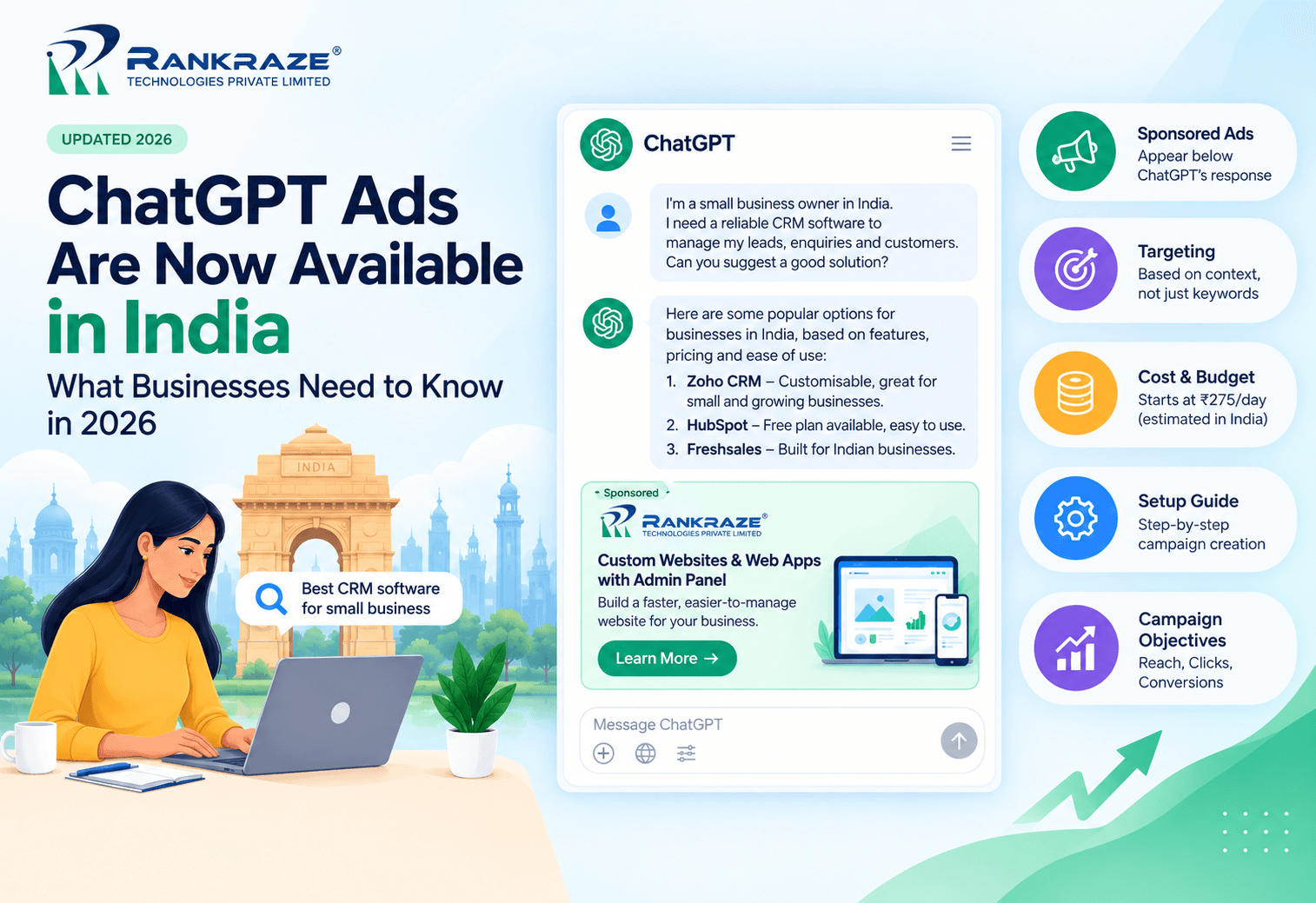
ChatGPT Ads Are Now Available in India
ChatGPT is no longer only a place where people ask questions, research products, compare services, and look for recommendations.
It is becoming a new advertising environment for businesses.
OpenAI has made its Ads Manager available in India, allowing eligible advertisers to create and manage ChatGPT advertising campaigns themselves. India is currently listed among the countries where ChatGPT Ads Manager is available.
This creates an interesting opportunity for Indian businesses because the advertising environment is different from traditional platforms such as Google and Meta.
Instead of relying only on keywords or social interests, ChatGPT Ads can use the context of what a person is trying to accomplish when deciding which ads may be relevant.
So, what exactly are ChatGPT Ads?
How does targeting work?
How much does advertising on ChatGPT cost in India?
And most importantly, is it worth testing for your business?
Let’s break it down.
What Are ChatGPT Ads?
ChatGPT Ads are sponsored advertisements that can appear alongside ChatGPT responses.
They are visually separated from the AI-generated answer and clearly identified as advertisements.
One important distinction is that advertising does not control ChatGPT’s answers.
OpenAI states that ads are separate from the response-generation system. Advertisers also do not receive access to users’ private conversations, chat history, memories, or personal information.
This is important for both advertisers and users.
The basic idea is:
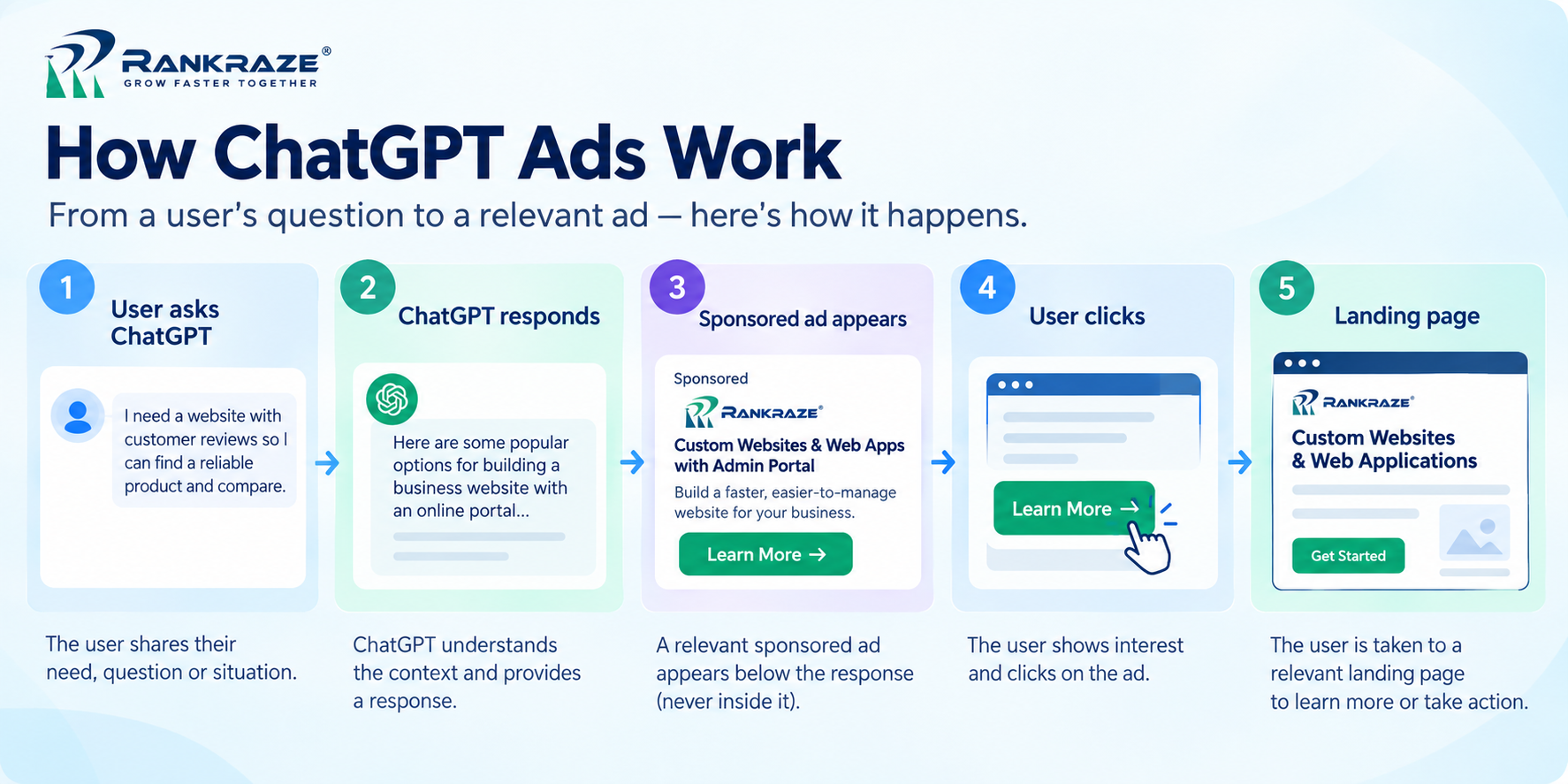
User asks ChatGPT → ChatGPT understands the context → Relevant advertising may appear separately from the answer.
This makes ChatGPT Ads different from traditional search advertising.
Why ChatGPT Ads Could Be Different From Google Ads
Google Ads generally begins with a search query.
For example:
“Best CRM software for small business”
A business can bid on keywords related to that search.
ChatGPT works differently.
A user might have a longer conversation such as:
“I’m starting a small business and need a CRM that can manage leads, follow-ups and customer communication. What should I consider?”
The important information isn’t necessarily one keyword.
It is the intent and context behind the conversation.
This is one of the biggest things businesses need to understand about ChatGPT advertising.
The opportunity isn’t simply:
“Put our keyword into ChatGPT.”
It is:
“Make our product relevant to the situations in which our potential customer needs it.”
How ChatGPT Ads Target Users
One of the most interesting parts of ChatGPT advertising is the use of context hints.
Context hints help describe:
What your product or service does
Who it is useful for
What problem it solves
When a customer might need it
What situations may make the product relevant
These are not traditional exact-match keywords.
They are also not a guarantee that an ad will appear whenever a particular phrase is mentioned.
Instead, they help describe the situations where your advertising may be relevant.
For example, a software company selling CRM software could create context around:
Product: CRM software
Audience: Small and medium-sized businesses
Use cases: Lead management, sales follow-up, customer management
Customer situation: Businesses looking to replace spreadsheets or manage growing sales teams
The goal is to help ChatGPT understand when the product could be useful.
How a ChatGPT Ad Campaign Is Structured
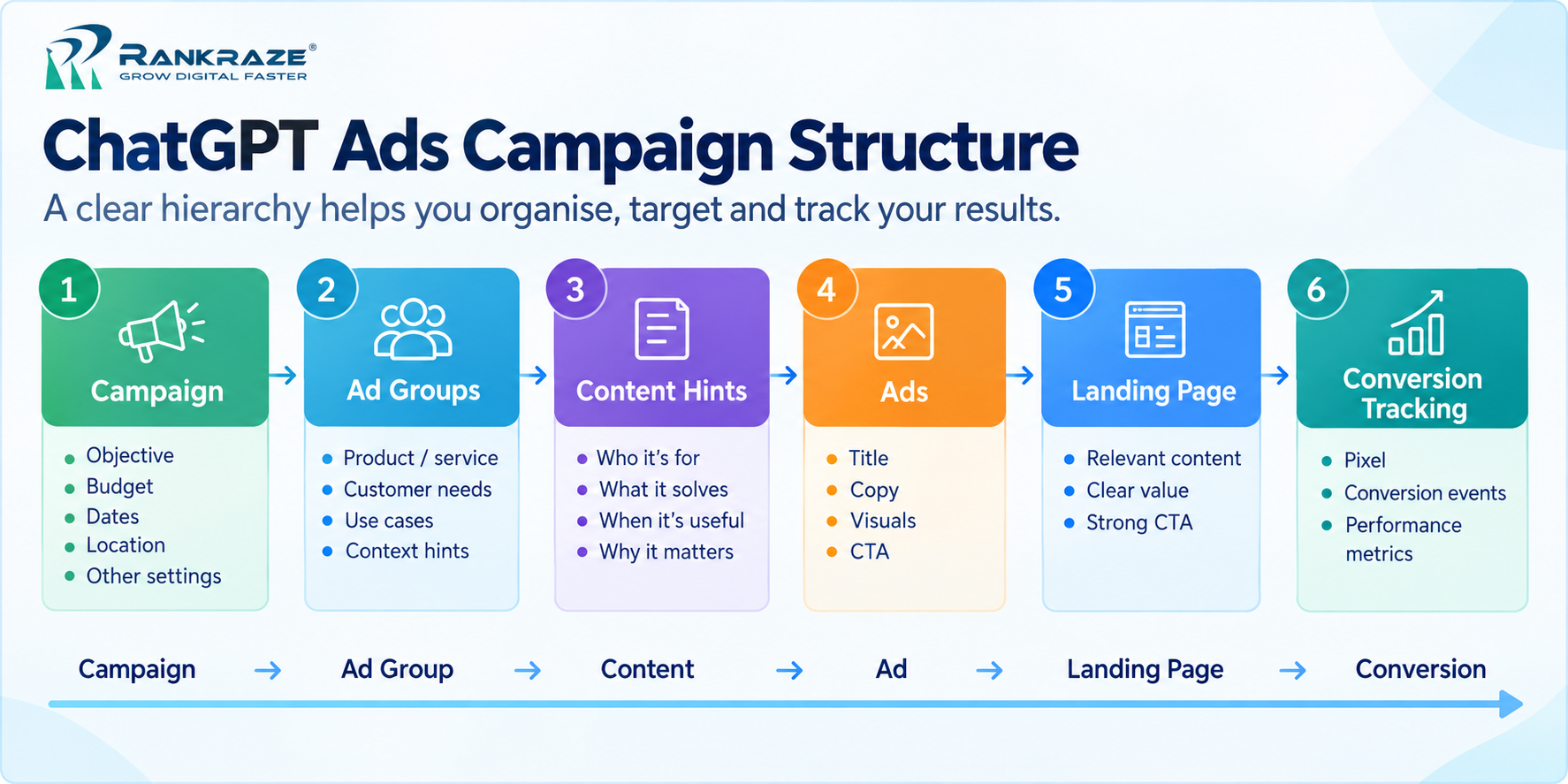
A typical campaign can be thought of in three levels:
1. Campaign
This is where you define the overall campaign objective, budget, dates, location and other campaign-level settings.
2. Ad Groups
Ad groups allow advertisers to organize products, services or themes around different customer needs.
For example:
CRM for sales teams
Lead management software
Customer support software
3. Ads
The actual advertisement contains elements such as the title, copy and landing page.
This means businesses shouldn’t treat the ad itself as the entire strategy.
The campaign → ad group → context → ad → landing page → conversion journey needs to make sense as one experience.
Can You Target Indian Cities or Locations?
ChatGPT Ads supports location targeting where available.
OpenAI’s campaign documentation states that advertisers can target countries and, where supported, locations such as states or regions, cities, DMAs and postal codes.
However, location availability can vary by country and should be checked inside Ads Manager when setting up the campaign.
For Indian advertisers, this means location targeting should be checked during campaign creation rather than assuming that every geographic targeting option is available for every account.
What Campaign Objectives Are Available?
ChatGPT Ads currently supports different campaign approaches depending on the outcome a business wants.
These include:
Reach / Views
Designed for businesses looking to maximize visibility and exposure.
The billing model is based on impressions.
Clicks
Designed to drive traffic to a website or landing page.
The advertiser is charged based on valid clicks.
Conversions
Conversion-focused campaigns can optimize toward a tracked conversion event such as a lead submission, signup or purchase.
For businesses focused on lead generation or sales, conversion measurement becomes particularly important.
OpenAI’s current campaign documentation describes CPM, CPC and conversion-optimized campaign options.
How Much Do ChatGPT Ads Cost in India?
This is probably one of the first questions businesses will ask.
The important thing is that there isn’t one fixed “ChatGPT Ads price.”
Cost depends on the campaign objective, bidding approach, competition, delivery and performance.
However, OpenAI currently lists ₹725 as the minimum daily campaign budget for India.
That does not mean every advertiser will spend only ₹725 per day.
It is the minimum campaign budget shown for India.
Advertisers can choose either a daily budget or a campaign-total budget.
With a daily budget, OpenAI currently describes it as an average daily amount over a seven-day period. Daily spending can vary, while the applicable seven-day spending limit remains tied to the selected budget.
Should businesses start with a large budget?
Not necessarily.
For a new advertising channel, the smarter approach is usually to test:
One clear business objective
A small number of strong ad groups
Multiple creative variations
A relevant landing page
Proper conversion tracking
Then increase the budget after identifying what actually works.
Does ChatGPT Ads Have a Fixed CPC?
There is no single public CPC that applies to every business.
ChatGPT Ads can use CPC or CPM depending on the campaign objective, while conversion-focused campaigns can use conversion optimization.
The actual cost can vary based on factors such as delivery, engagement and the pricing model selected.
Therefore, businesses should be careful with claims such as:
“ChatGPT Ads cost ₹X per click.”
There isn’t one universal rate that applies to every advertiser.
The better approach is to run controlled tests and measure the actual cost for your business.
How to Advertise on ChatGPT in India
The general process looks like this:
Step 1: Create Your Ads Manager Account
Businesses can access OpenAI’s advertising platform and complete the required account and billing setup.
Step 2: Create a Campaign
Choose:
Campaign objective
Budget
Start and end dates
Target countries or supported locations
Other applicable campaign settings
Step 3: Create Ad Groups
Organize your products or services around specific themes, customer needs or use cases.
Step 4: Add Context Hints
Describe:
Who your product is for
What problem it solves
When someone might need it
Why it may be useful
Step 5: Create Multiple Ads
Develop different titles and copy variations rather than relying on one advertisement.
Step 6: Add Conversion Tracking
If your objective is lead generation, sales or another measurable action, set up appropriate conversion tracking.
Step 7: Launch and Monitor
After launch, monitor impressions, clicks, spend, CTR, CPC and conversions where tracking is configured.
OpenAI’s Ads Manager documentation follows this general campaign → ad group → ad → launch and measurement workflow.
Why Conversion Tracking Matters
Getting clicks isn’t the same as getting customers.
Imagine a company spends ₹20,000 on ChatGPT Ads.
It receives:
10,000 impressions
300 clicks
20 enquiries
The important question isn’t just:
“How many people clicked?”
It’s:
“How many of those clicks became qualified leads or customers?”
That’s why businesses running conversion-focused campaigns should set up proper measurement.
OpenAI supports conversion measurement through tools such as its Pixel and Conversions API, depending on the campaign setup.
This allows advertisers to understand what happens after someone interacts with an advertisement.
A Practical Example: How a B2B Company Could Use ChatGPT Ads
Let’s say a company provides business automation software.
Instead of creating a generic advertisement saying:
“The #1 Business Automation Software”
the company could build its campaign around customer situations.
Campaign Objective
Conversions
Ad Group
Business automation for growing companies
Context
Businesses looking to reduce manual processes, organize operations and automate repetitive tasks.
Ad
Title: Automate repetitive business processes
Copy:
Reduce manual work, organize your business operations and give your team more time to focus on growth.
CTA: Learn More
Landing Page
A dedicated page explaining:
What the software does
Who it is for
Key features
Pricing or demo information
Customer proof
Clear enquiry/demo CTA
The important part is that the context, advertisement and landing page all tell the same story.
This is where businesses need to think beyond simply creating an advertisement.
ChatGPT Ads vs Google Ads vs Meta Ads
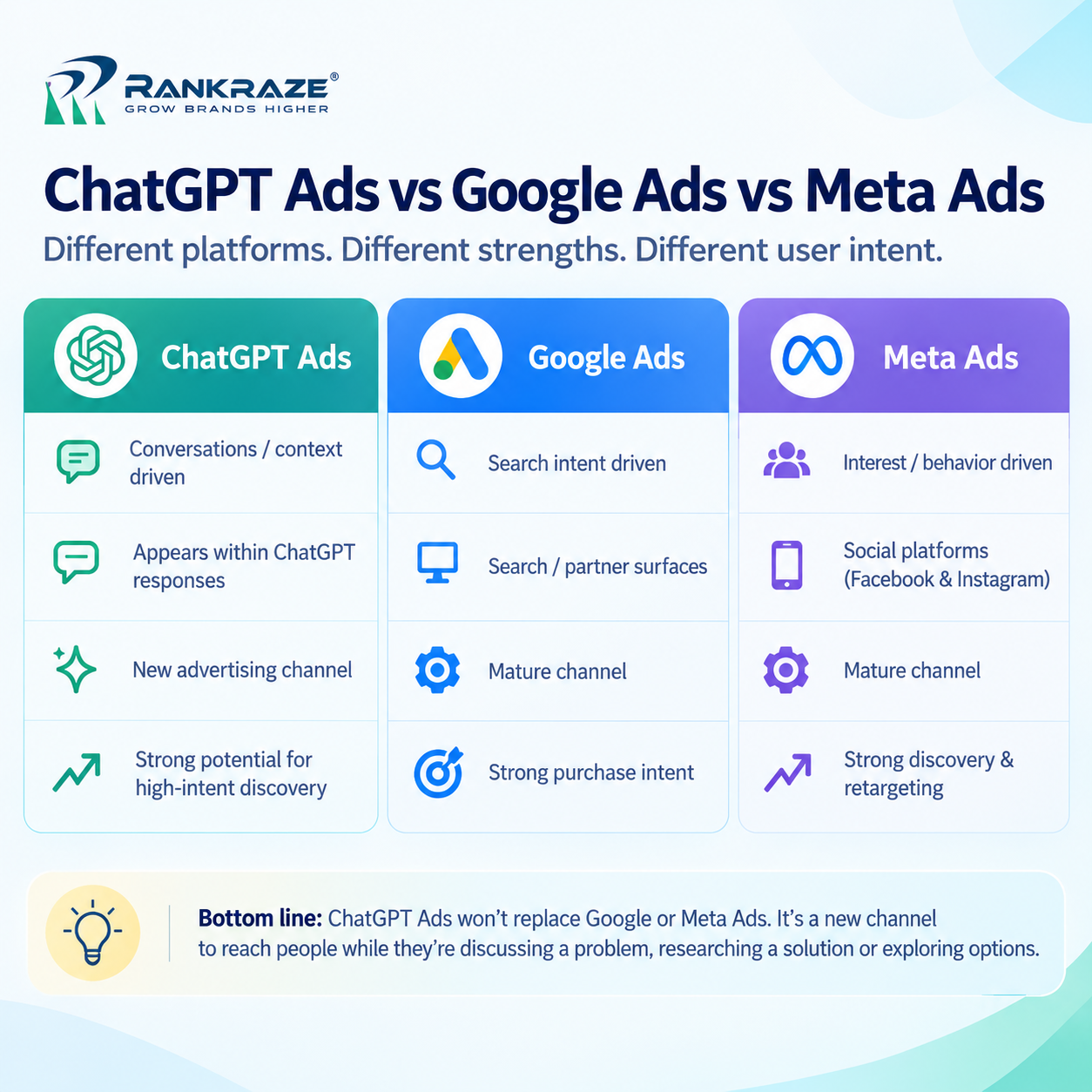
Each platform serves a different purpose.
Platform | Strongest Use Case | User Intent |
|---|---|---|
Search-driven demand | High | |
Discovery, awareness & demand generation | Often lower / interest-based | |
ChatGPT Ads | Contextual discovery around conversations | Context-driven |
This does not mean ChatGPT Ads will replace Google or Meta Ads.
They solve different problems.
A customer searching Google for:
“SEO agency in Chennai”
has already expressed a very direct search intent.
A person having a ChatGPT conversation about:
“How can I get more leads for my business?”
may not have decided which service or company they want yet.
That difference could make ChatGPT particularly interesting for businesses selling solutions rather than simple commodities.
What Makes a Good ChatGPT Ad?
A good ChatGPT advertisement should be:
Relevant
The product should genuinely fit the customer’s situation.
Specific
Avoid vague claims such as:
“We are the best solution.”
Explain what you actually solve.
Benefit-focused
Tell the customer what they can achieve.
Consistent
The ad, context and landing page should communicate the same value proposition.
Easy to understand
The user should quickly understand:
What is this?
Why should I care?
What should I do next?
OpenAI’s own advertising guidance emphasizes clear, specific and benefit-focused ad copy and recommends testing multiple creative variations.
Common Mistakes Businesses Should Avoid
1. Treating ChatGPT Ads Like Google Search Ads
ChatGPT is not simply another keyword search engine.
Thinking only in terms of keywords can limit the potential of the platform.
2. Using Generic Context
“People interested in our product” isn’t very useful.
Describe actual customer situations and use cases.
3. Sending Everyone to the Homepage
A relevant landing page will generally make more sense than sending every user to a generic homepage.
4. Running Only One Ad
Test different messages and value propositions.
5. Ignoring Conversion Tracking
Clicks without conversion data make it difficult to understand business performance.
6. Expecting Immediate Results
ChatGPT Ads are still a relatively new advertising channel.
Businesses should approach the platform as a testing opportunity rather than assuming it will immediately outperform established channels.
Who Should Consider Testing ChatGPT Ads?
ChatGPT Ads may be particularly interesting for businesses where customers spend time researching, comparing or explaining a problem before making a purchase.
Potential categories include:
SaaS companies
B2B software
Business services
Professional services
Education
E-commerce
Technology companies
Travel and hospitality
Agencies
Subscription businesses
However, suitability depends heavily on the product, audience, landing page and campaign objective.
A new advertising platform isn’t automatically the right platform for every business.
What Businesses Should Know About Privacy
Advertising on ChatGPT is different from buying access to user conversations.
OpenAI states that advertisers do not receive users’ private conversations, chat history, memories, name, email address, precise location or sensitive personal information.
Advertisers receive aggregated campaign reporting rather than individual users’ private conversations.
This distinction is important when considering ChatGPT as an advertising channel.
Businesses should also follow OpenAI’s advertising policies and applicable laws when creating campaigns.
Is ChatGPT Advertising Available to Everyone?
Availability depends on the advertiser, account, market and applicable policies.
OpenAI currently lists India as an available market for Ads Manager.
However, not every product or advertising category is automatically eligible.
Businesses should review the current advertising policies before planning a campaign, particularly if they operate in regulated or sensitive industries.
Should Indian Businesses Start Advertising on ChatGPT?
Our view at Rankraze is simple:
Don’t replace your existing advertising channels yet. Test ChatGPT Ads alongside them.
Google Ads can capture people who are actively searching.
Meta Ads can create demand and reach audiences based on interests and behaviour.
ChatGPT Ads introduce another opportunity: reaching people while they are actively discussing a problem, researching an option or trying to understand what solution they need.
That makes it worth testing.
But the real advantage won’t come from simply being one of the first businesses to advertise on ChatGPT.
It will come from understanding how people describe their problems and what context makes your product relevant to them.
The Bigger Opportunity for Digital Marketing
Advertising is gradually moving from:
“What keyword did someone type?”
towards:
“What is this person actually trying to accomplish?”
That’s a significant shift.
For marketers, this means understanding customer intent becomes even more important.
Instead of creating hundreds of keyword variations, marketers may need to think more deeply about:
Customer problems
Customer situations
Buying journeys
Questions customers ask
Product use cases
Decision-making behaviour
Landing-page relevance
ChatGPT Ads are still new, but the underlying change in how people discover information is something marketers should pay attention to.
Frequently Asked Questions
Are ChatGPT Ads available in India?
Yes. OpenAI currently lists India as an available market for ChatGPT Ads Manager.
How much do ChatGPT Ads cost in India?
The current minimum daily campaign budget listed by OpenAI for India is ₹725. Actual advertising costs depend on campaign objective, bidding, delivery and performance.
Can businesses advertise their products on ChatGPT?
Eligible advertisers can create campaigns through OpenAI’s Ads Manager, subject to account eligibility and advertising policies.
Is ChatGPT Ads the same as Google Ads?
No. Google Ads is primarily built around search and other Google advertising placements, while ChatGPT Ads are designed around advertising within the ChatGPT experience.
Can ChatGPT Ads generate leads?
Yes, businesses can use conversion-focused campaigns and track conversion events such as lead submissions, depending on the campaign setup.
Can ChatGPT Ads target specific locations?
Location targeting is available where supported. OpenAI currently documents country targeting as well as states/regions, cities, DMAs and postal codes where available.
Do advertisers see users’ ChatGPT conversations?
No. OpenAI states that advertisers do not receive access to users’ private conversations or chat history.
Should businesses stop Google or Meta Ads and move to ChatGPT Ads?
No. ChatGPT Ads should currently be viewed as an additional channel to test, not an automatic replacement for existing advertising platforms.
Final Thoughts
ChatGPT Ads are one of the more interesting developments in digital advertising in 2026.
For Indian businesses, the important question isn’t:
“Should we advertise on ChatGPT because it’s new?”
The better question is:
“Are our potential customers using ChatGPT to research the problems our business solves?”
If the answer is yes, this could become an interesting channel to test.
The businesses that learn how to connect customer intent + context + useful messaging + strong landing pages + conversion tracking will be better positioned to take advantage of it.
At Rankraze, we see ChatGPT Ads as another layer in the evolving digital marketing ecosystem—not a replacement for Google Ads, Meta Ads or SEO, but a new opportunity to experiment with intent-driven customer acquisition.
The platform is new. The opportunity is worth testing.
.png&w=828&q=75)